Key Takeaways
- A dental implant is generally the longest-lasting option and helps preserve jawbone health, but it involves a surgical procedure and the longest treatment timeline, often several months.
- A dental bridge can restore a missing tooth more quickly and without surgery, but it typically requires reshaping the healthy teeth next to the gap, and generally lasts around 5 to 15 years.
- Dentures are usually the most affordable and least invasive option upfront, though they often need more adjustments and maintenance over time.
- Costs for all three vary considerably depending on the case, materials, and number of teeth involved, so the figures here should be treated as general ranges rather than a quote, with a personal consultation being the best way to get an accurate picture.
Losing a tooth, whether from decay, injury, or age, naturally brings up the question of what to do next. The good news is that there are several good options, and the right one really does depend on your situation, your budget, and what matters most to you, not a single "best" answer that applies to everyone.
This guide walks through how dental implants, bridges, and dentures compare, gently and honestly, so you can have a more informed conversation with your dentist.
What Is a Dental Implant?
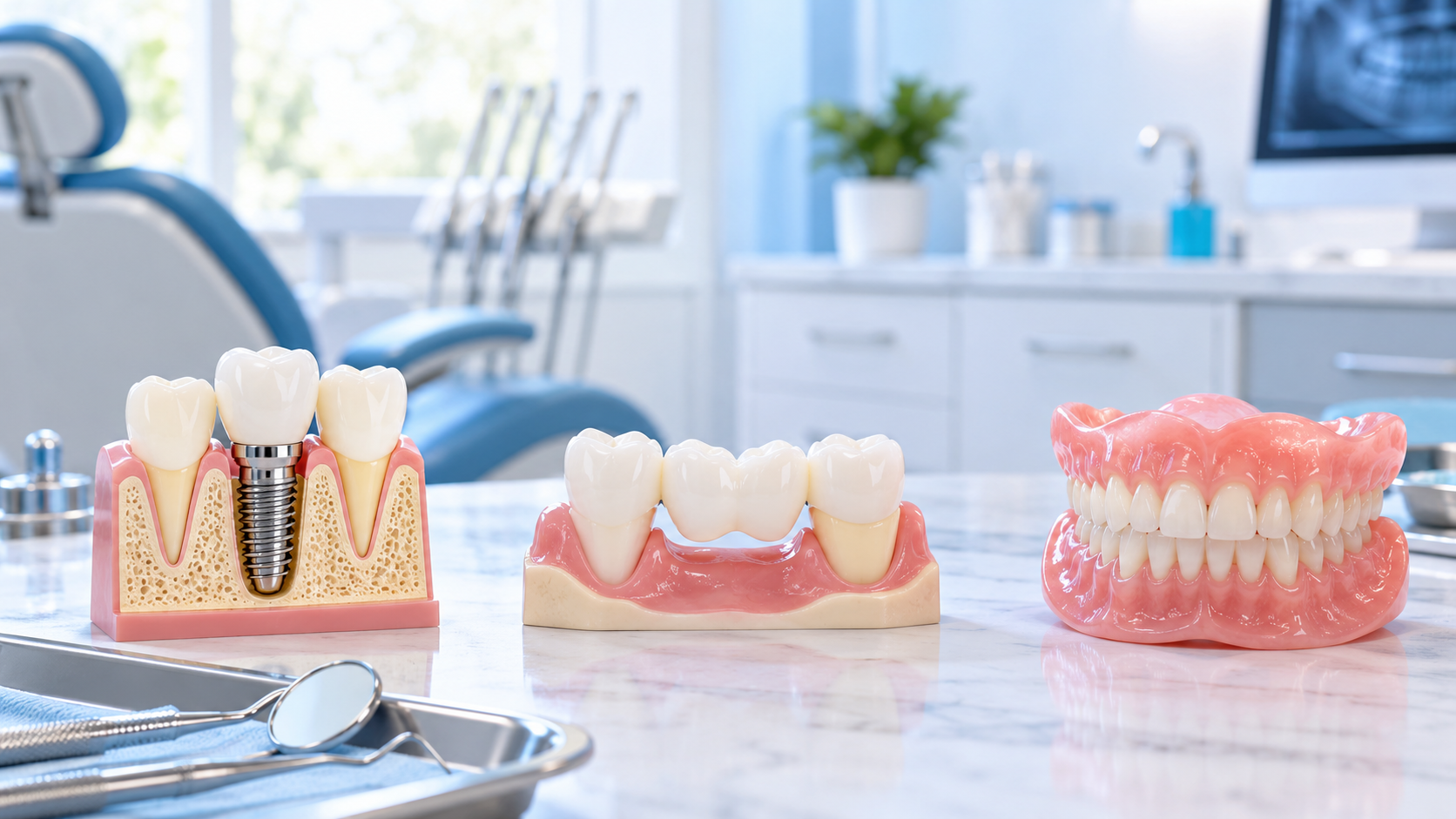
A dental implant replaces a missing tooth from the root up. A small titanium post is placed into the jawbone, where it gradually fuses with the bone over a few months in a process called osseointegration, and a crown is then attached on top. Because the implant replaces the root as well as the visible tooth, it also helps stimulate the jawbone the way a natural tooth root would, which can help preserve bone structure over time.
What Is a Dental Bridge?
A dental bridge fills the gap left by a missing tooth using a false tooth anchored to the natural teeth on either side. To support the bridge, those neighbouring teeth are generally reshaped and fitted with crowns. This means a bridge does not require surgery and can usually be completed over a couple of visits, which some patients find more comfortable than the implant process, though it does mean altering otherwise healthy teeth.
What Are Dentures?
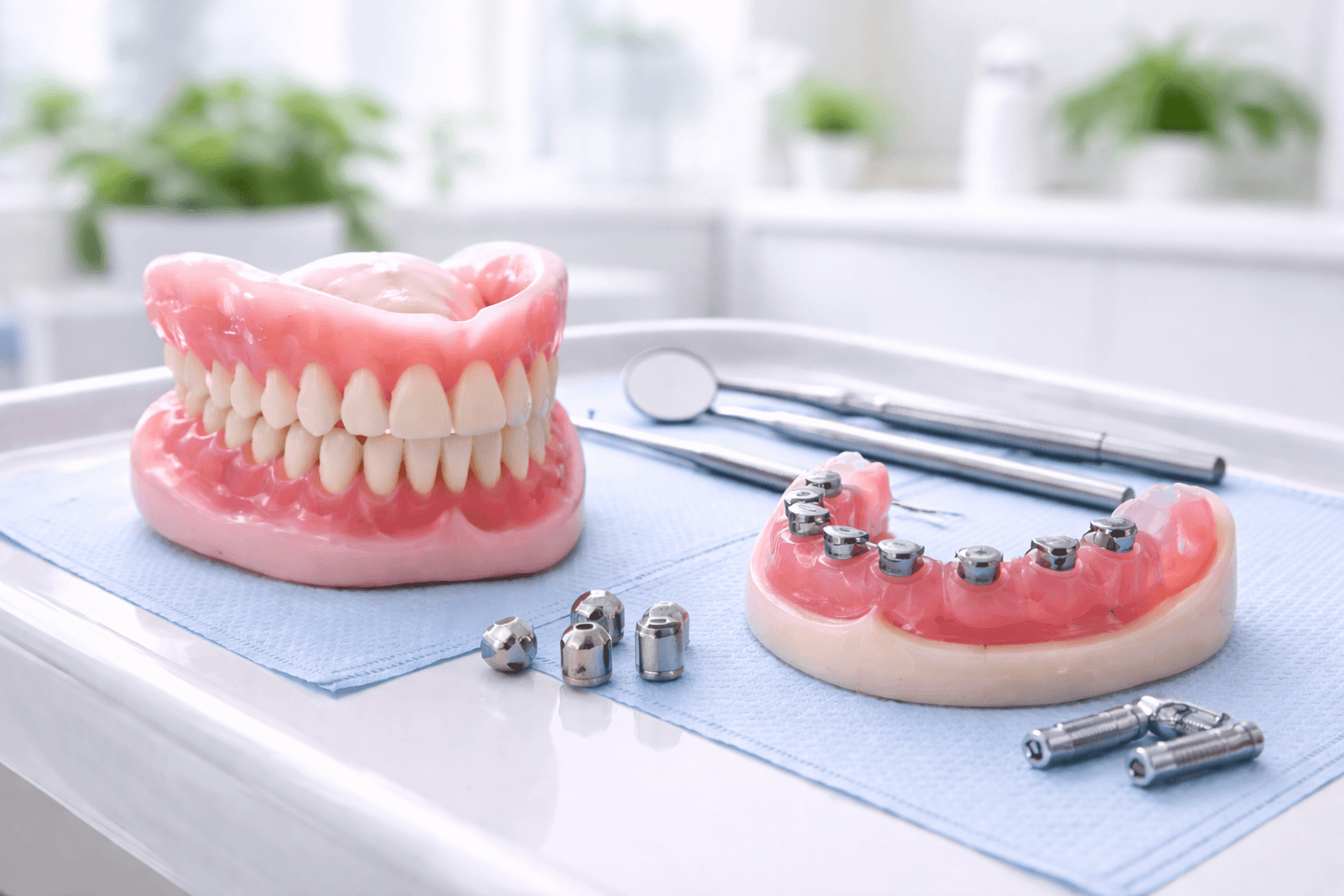
Dentures are removable replacement teeth, available as a partial denture for one or a few missing teeth, or a complete denture when more teeth are missing. They are generally the quickest and most affordable way to restore a smile and chewing ability, though they tend to need more regular adjustments over time as the shape of your gums gradually changes.
Comparing the Three Options
| Dental Implant | Dental Bridge | Dentures | |
|---|---|---|---|
| Involves surgery | Yes | No | No |
| Typical timeline | Longest, often several months | Moderate, generally a few weeks | Usually the quickest |
| Affects neighbouring teeth | No | Yes, generally reshaped | No |
| Typical lifespan | Often decades with good care | Commonly around 5 to 15 years | Varies, generally needs periodic adjustment |
| Helps preserve jawbone | Yes | No | No |
| Relative cost | Generally the highest | Moderate | Generally the most affordable |
How Much Do These Options Cost in Malaysia?
Costs for all three options vary quite a bit depending on the clinic, the materials used, and how many teeth are involved, so it's worth treating any figure as a general starting point rather than a fixed price. As a rough guide, dentures tend to be the most budget-friendly option, bridges generally sit in the middle, and implants are typically the most significant investment, partly reflecting the surgical procedure and the materials involved.
The only way to get an accurate number for your own situation is a proper consultation and examination, since the right treatment plan (and its cost) depends on factors unique to your mouth.
Which Option Might Suit You?
If preserving your jawbone health and choosing a long-term solution matters most to you, and you're comfortable with a longer treatment timeline, an implant is often worth discussing with your dentist. If you'd rather avoid surgery and want a quicker fix, and your neighbouring teeth could use crowns anyway, a bridge may be a comfortable middle ground.
If affordability and a non-invasive approach are your priority, especially if several teeth need replacing, dentures are often a sensible starting point, with the option to consider other treatments later if needed.
There's no wrong choice here, only the option that fits your health, comfort, and budget best right now.
Missing Your Two Front Teeth: Implant or Bridge?
When it's a front tooth specifically, implants are often the preferred option, mainly because they don't rely on your neighbouring teeth for support and they help prevent the subtle bone loss that can eventually make the gum line look sunken, something that matters more visibly at the front of the mouth than further back. A bridge can still look very natural, especially with modern ceramic materials, and gives a faster result, but it does mean preparing the two teeth next to the gap.
If you're missing two front teeth next to each other, the right approach isn't always "two separate implants." Depending on the available bone and the space involved, your dentist may suggest an implant-supported bridge spanning both gaps instead, since placing two individual implants too close together isn't always the ideal solution.
This is very case-specific, so it's genuinely one of those situations where a proper assessment makes a real difference to the recommendation.
Not sure whether a dental bridge or implant is the right solution for your missing front teeth? Our experienced dentists can assess your oral health, bone condition, and aesthetic needs to recommend the most suitable treatment option. Book a consultation today for personalised advice and a treatment plan tailored to your smile.
Frequently Asked Questions
Which is better, a dental implant or a bridge?
Neither is universally "better." An implant generally offers a longer-lasting, bone-preserving solution but requires surgery and more time, while a bridge is quicker and avoids surgery but involves reshaping nearby teeth and generally has a shorter lifespan.
Are dentures a permanent solution?
Dentures are removable and generally need periodic adjustment or replacement as your gums change shape over time, so they're best thought of as an ongoing solution rather than a one-time fix.
Can I switch from dentures to implants later?
In many cases, yes, though this depends on your individual oral health and bone condition at the time, so it's best discussed directly with a dentist.
I need an implant near my sinus. Is that a problem?
It can be a consideration, mainly for upper back teeth, since the sinus can sit close to the jawbone in that area, especially if a tooth has been missing for a while and the bone has thinned. If there isn't enough bone, a dentist may recommend a sinus lift, a procedure that adds bone in that area before or during implant placement. It sounds more alarming than it usually is in practice, and it's a well-established part of implant planning rather than something unusual.
Am I too young or too old for a dental implant?
On the older end, there's generally no upper age limit for implants; overall health and bone quality matter far more than age itself, and implants are routinely placed successfully in patients well into their senior years.
On the younger end, it's a different story: implants are usually not recommended until the jaw has finished growing, typically the late teens, since placing one in bone that's still developing can affect how it settles. If you're younger and missing a tooth, a dentist will usually suggest a temporary option, like a removable retainer or a bridge, until the timing is right for an implant.
How do I know which option is right for me?
This really depends on your specific situation, including how many teeth are missing, your overall oral health, your budget, and your personal comfort with each procedure. A consultation is the most reliable way to get a recommendation tailored to you.
Talk to Us About Your Options
Choosing between a dental implant, bridge, or denture is a personal decision, and it's completely normal to have questions. At Family Dental, we take the time to walk through each option with you in a relaxed, judgment-free setting, so you can make the choice that feels right for your smile and your life.
Contact us to arrange a consultation and get a clearer picture of what's involved for your specific situation.