Thinking about straightening your teeth but not sure whether to go with clear aligners like Invisalign or traditional braces? You are not alone. It is one of the most common questions patients ask at dental clinics across Malaysia — and the honest answer is: it depends.
Both orthodontic treatments are highly effective at correcting misaligned teeth. Both are widely available at dental clinics in Malaysia in 2026. But they work differently, cost differently, and suit different lifestyles and dental situations. Choosing between them is not just about aesthetics — it is about finding the treatment that will actually work best for your specific teeth, your daily routine, and your long-term goals.
This guide gives you a clear, honest comparison so you can walk into your consultation fully informed.
Key Takeaways
- Both Invisalign aligners and traditional braces can achieve excellent orthodontic results — the right choice depends on your dental complexity, lifestyle, and budget.
- Clear aligners are removable, nearly invisible, and well-suited to mild to moderate crowding and spacing issues — particularly for working adults and older teens.
- Braces (metal or ceramic) are fixed, more powerful for complex bite corrections, and generally more affordable — making them the preferred choice for severe cases and younger patients.
- Orthodontic treatment in Malaysia ranges from approximately RM 3,000 to RM 12,000 depending on the type of system, complexity, and clinic location.
- The best way to decide is through a proper clinical assessment with a dentist experienced in both systems — what works for your colleague or friend may not be the right fit for your teeth.
What Is the Difference Between Clear Aligners and Braces?
Both systems move your teeth into better alignment over time — but they achieve this in fundamentally different ways.
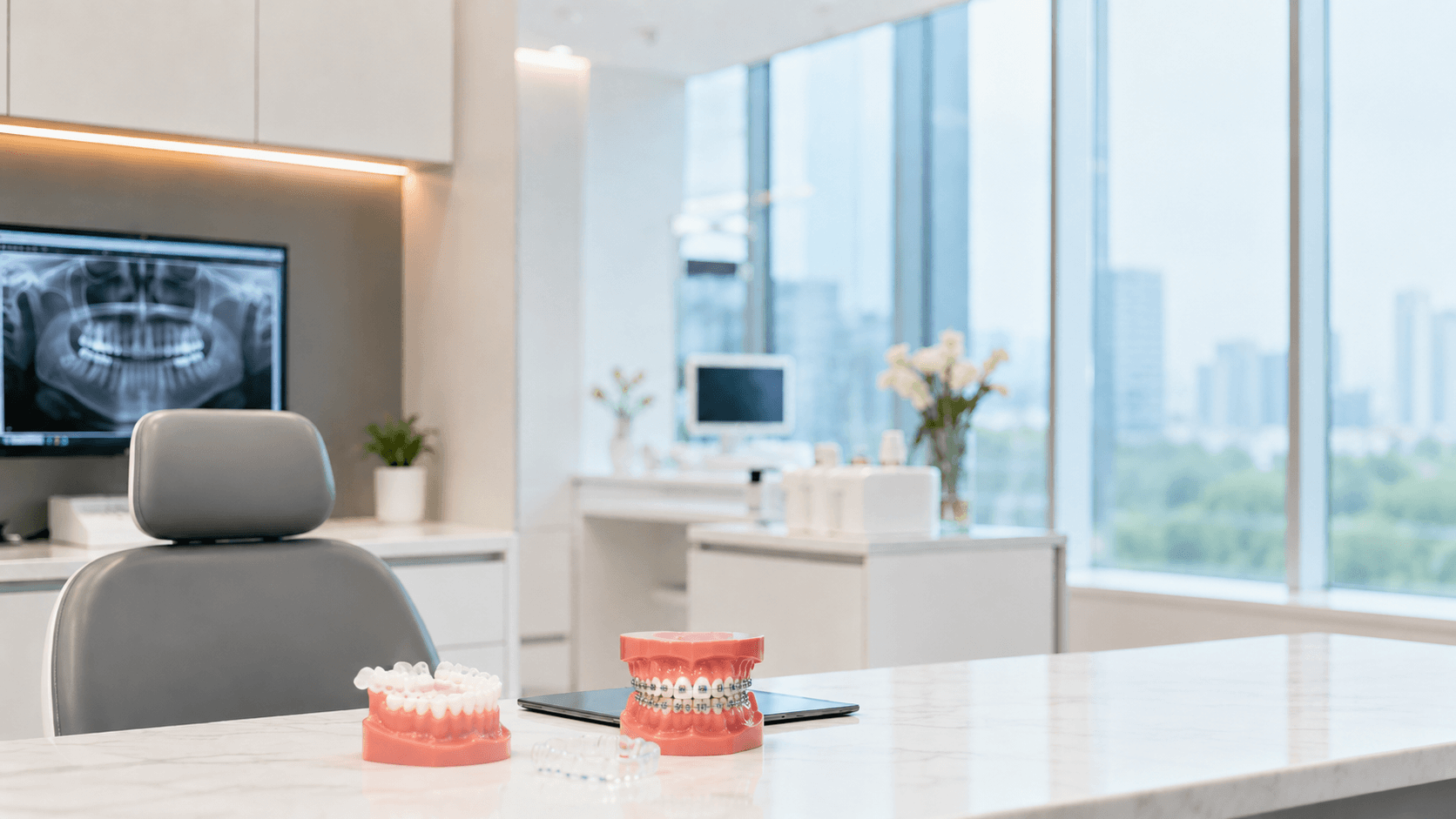
Braces are fixed orthodontic appliances bonded directly to the surface of your teeth. Metal or ceramic brackets are attached to each tooth and connected by an archwire that exerts consistent pressure, gradually shifting teeth into the correct position. Braces are adjusted periodically by your dentist throughout the treatment period.
Clear aligners — of which Invisalign is the most widely recognised brand globally — use a series of custom-made, removable transparent trays. Each set of trays is worn for approximately one to two weeks before being replaced by the next in the sequence. Each tray is slightly different, applying controlled pressure to specific teeth at each stage of the treatment plan. Because they are clear and removable, they are far less visible and less disruptive to daily life than fixed braces.
How Do Clear Aligners (Invisalign) Work?
Invisalign aligners and other clear aligner systems use digital 3D scanning technology to map your teeth and plan the full movement sequence before treatment begins. You can often see a simulation of your expected final result before a single tray is made.
The aligners are worn over your teeth for 20 to 22 hours per day. They are removed only for eating, drinking anything other than water, and oral hygiene. Each new set of trays advances the tooth movement incrementally — and because each tray is precision-engineered for your specific dental anatomy, the treatment is highly customised.
Small tooth-coloured attachments (called buttons or engagers) are sometimes bonded to teeth to help the aligners grip and apply force to specific teeth more effectively. These are barely visible but are an important part of how aligners achieve certain movements.
Clear aligners are most effective for:
- Mild to moderate crowding and spacing
- Minor bite discrepancies
- Relapse after previous orthodontic treatment
- Adults and older teens with good treatment compliance
How Do Braces Work?
Traditional braces apply continuous, consistent force to your teeth through the combination of brackets bonded to teeth and an archwire that connects them. Unlike aligners, which are replaced at home every couple of weeks, braces are adjusted by your dentist at clinic visits — typically every four to eight weeks — by changing the wire or applying elastic ligatures.
Because braces are always attached to your teeth, their force is constant and uninterrupted. This makes them particularly effective for:
- Moderate to severe crowding
- Significant bite corrections — overbite, underbite, crossbite, open bite
- Complex rotations and tooth movements
- Cases involving growing jaws (younger patients)
- Patients who may struggle with the discipline of wearing aligners for 20–22 hours daily
Metal braces remain the most commonly prescribed orthodontic treatment in Malaysia due to their clinical versatility and affordability. Ceramic braces — made from tooth-coloured material — offer a more aesthetic alternative while retaining the mechanical advantages of a fixed appliance.
Clear Aligners vs Braces: Side-by-Side Comparison
| Feature | Clear Aligners (Invisalign) | Metal Braces | Ceramic Braces |
| Visibility | Nearly invisible | Visible | Less visible |
| Removability | Yes — removable | No — fixed | No — fixed |
| Comfort | Smooth plastic, less irritation | Can cause initial soreness | Similar to metal, smoother surface |
| Effectiveness | Best for mild to moderate cases | Best for mild to complex cases | Mild to moderate to complex |
| Treatment duration | 12–24 months (typical) | 18–36 months (typical) | 18–36 months (typical) |
| Oral hygiene | Easier — remove to brush and floss | Requires more effort around brackets | Similar to metal braces |
| Dietary restrictions | None — remove before eating | Yes — avoid hard/sticky foods | Yes — similar restrictions |
| Compliance required | High — must wear 20–22 hrs/day | Low — fixed, no patient compliance needed | Low — fixed |
| Cost in Malaysia | RM 6,000 – RM 12,000+ | RM 3,000 – RM 7,000 | RM 4,500 – RM 9,000 |
| Best for | Adults, mild-moderate cases | Any age, all complexities | Aesthetics-conscious patients |
Cost of Orthodontic Treatment in Malaysia (2026)
Understanding the cost of orthodontic treatment in Malaysia helps you plan your budget and understand what you are paying for.
Metal Braces
RM 3,000 – RM 7,000
Metal braces remain the most affordable fixed orthodontic option in Malaysia. The cost varies based on case complexity, treatment duration, and clinic location. Urban clinics in cities like Penang, Kuala Lumpur, and Johor Bahru tend to be priced at the higher end of this range.
Ceramic Braces
RM 4,500 – RM 9,000
Ceramic braces cost more than metal due to the material and the additional care required during placement and adjustment. They offer a less conspicuous appearance while providing the same mechanical effectiveness as metal braces.
Invisalign Aligners
RM 6,000 – RM 12,000+
Invisalign is the most widely available clear aligner brand in Malaysia. The cost reflects the advanced digital planning technology, custom aligner fabrication, and the brand's clinical development programme. Other clear aligner systems are available at lower price points, though clinical outcomes depend heavily on the quality of the digital planning and the experience of the treating dentist.
What Is Included in the Cost?
Most orthodontic treatment fees at reputable dental clinics cover:
- Initial consultation and clinical records (X-rays, photographs, study models or digital scans)
- All adjustment appointments throughout the treatment period
- Retainers at the end of treatment
- Minor repairs or replacements of standard components
Always clarify what is and is not included before signing a treatment agreement.
Who Is a Better Candidate for Clear Aligners?
Clear aligners tend to be the preferred choice for patients who:
Are adults or older teens.
Invisalign and clear aligner systems require strong compliance — wearing the trays for the prescribed 20 to 22 hours per day, every day. Younger teenagers who may be tempted to remove their aligners frequently, or who forget to replace them, will not achieve the intended results. For disciplined adult patients, compliance is rarely an issue.
Have mild to moderate alignment issues.
Clear aligners perform excellently for spacing, mild to moderate crowding, and minor bite corrections. They are less effective — and sometimes not suitable — for severe crowding, significant skeletal bite discrepancies, or complex rotational movements.
Have an aesthetics-driven concern.
Patients in professional environments, people who interact with the public frequently, or those who simply prefer not to have visible orthodontic appliances are well-suited to clear aligners.
Prioritise comfort and convenience.
The smooth plastic surface of aligners causes less soft tissue irritation than metal brackets. The ability to remove aligners for meals means no dietary restrictions — you can continue eating everything you enjoy throughout treatment.
Who Is a Better Candidate for Braces?
Braces are generally the recommended or required option for patients who:
Have complex or severe dental issues.
Significant crowding, large gaps, severe rotations, impacted teeth, and complex bite corrections — including overbites, underbites, and open bites — are generally treated more predictably with fixed braces than with aligners. The continuous force of a fixed appliance and the dentist's ability to apply precise mechanics at each adjustment gives braces an edge in these cases.
Are children or younger teenagers.
For growing patients whose jaw development is still active, fixed orthodontics allow the dentist to manage tooth movement in coordination with jaw growth — something aligner systems cannot do. For children, braces are the standard of care.
Are concerned about budget.
Metal braces remain the most affordable orthodontic treatment in Malaysia, and for straightforward to moderately complex cases, they deliver excellent clinical results at a lower total investment than clear aligner systems.
May struggle with compliance.
Some patients — honestly — know they will not wear aligners for 22 hours a day consistently. Fixed braces remove this variable entirely. The treatment works because it is always on.
The "Which Is Faster?" Question
Patients often ask whether aligners or braces are quicker. The honest answer is that treatment duration depends far more on the complexity of your case than on which system you choose.
For mild to moderate cases, clear aligners can sometimes achieve results in 12 to 18 months. For moderate to complex cases with braces, treatment typically ranges from 18 to 30 months. In some complex cases, braces are more efficient because they can achieve certain movements — particularly vertical and rotational control — more predictably than aligners.
Your dentist will give you a realistic treatment timeline estimate based on your specific clinical situation at your consultation — not based on what is fastest in general.
What Happens After Orthodontic Treatment?
Whether you choose aligners or braces, retainers are essential after treatment is complete. Without a retainer, teeth naturally shift back toward their original position over time — a process called relapse.
Most patients are provided with either a removable retainer to wear at night, a fixed (bonded) retainer behind the front teeth, or a combination of both. Wearing your retainer as prescribed is just as important as the treatment itself — it is what maintains the result you worked months or years to achieve.
So, Which Should You Choose?
If you are still uncertain, here is a simple decision guide:
| Your situation | Likely better option |
| Mild crowding or spacing, adult patient | Clear aligners |
| Moderate to severe crowding | Braces |
| Complex bite correction needed | Braces |
| Child or growing teenager | Braces |
| Professional or aesthetic concern | Clear aligners |
| Budget is a primary consideration | Metal braces |
| Concerned about food restrictions | Clear aligners |
| Worried about compliance | Braces |
The most important thing to remember is that no online guide can replace a proper clinical assessment. The right choice for your teeth depends on your dental anatomy, bite relationship, bone support, and what your treating dentist identifies during examination and X-ray review.
Book Your Orthodontic Consultation at Family Dental, Penang
At Family Dental, our experienced team provides orthodontic consultations for both braces and clear aligner treatments — giving you a clear picture of which option is clinically suitable for your teeth, alongside an honest breakdown of costs, timelines, and what to expect.
Whether you are considering invisalign aligners, traditional metal braces, or ceramic braces, we will take the time to explain your options properly — no pressure, no rush.
Book your consultation with Family Dental Penang today, or explore our braces treatment page to learn more about what we offer.
Not sure which braces suit you best? Explore our guide to compare self-ligating, ceramic, metal, lingual, and Invisalign options before starting your smile transformation.