A cavity in a young child does not always mean treatment has to begin with drilling.
For selected cases, dentists may recommend silver diamine fluoride for children, commonly called SDF, as a minimally invasive way to help stop or slow active tooth decay.
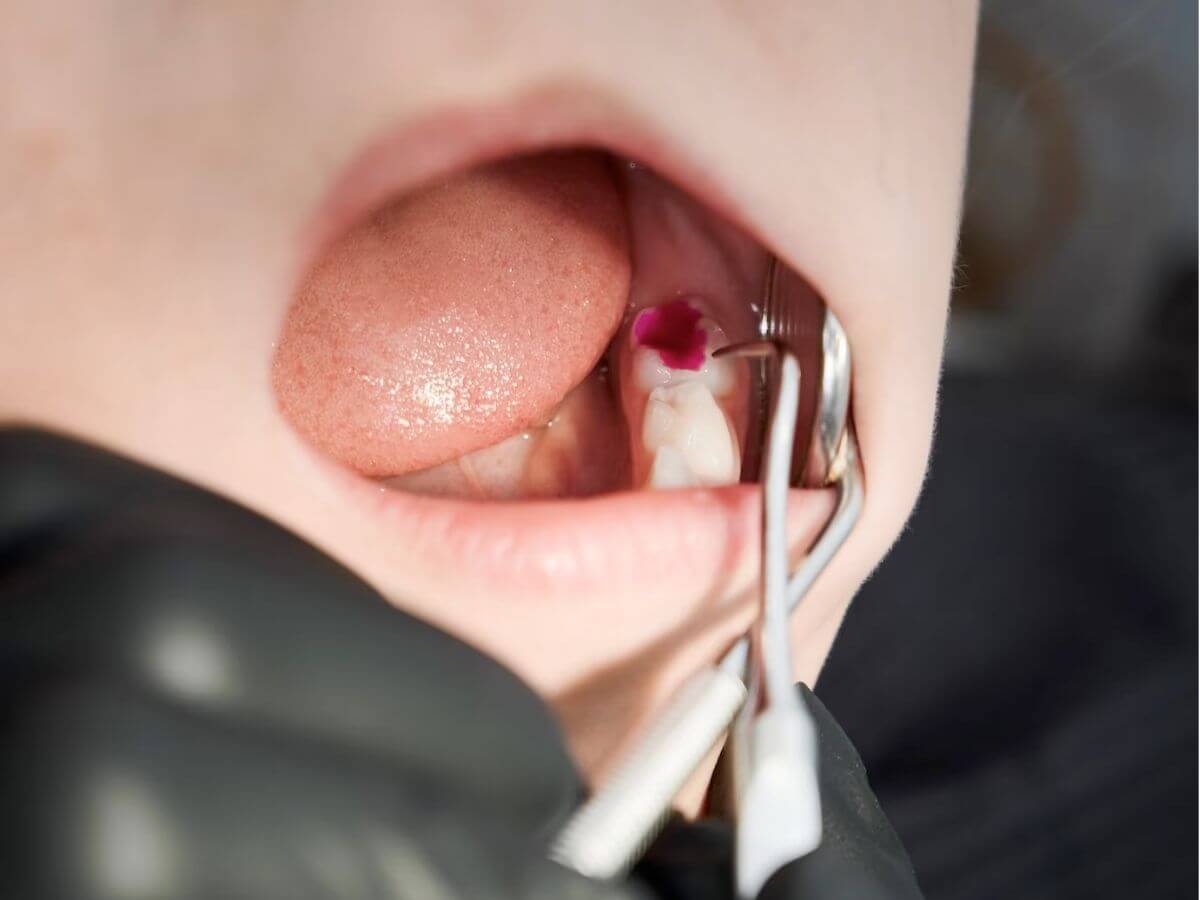
Silver diamine fluoride is applied directly to the decayed area of a tooth. The treatment is quick, does not require drilling for the SDF application itself, and can be particularly useful for young children who may find longer dental procedures difficult.
However, there is one important trade-off parents should understand before treatment:
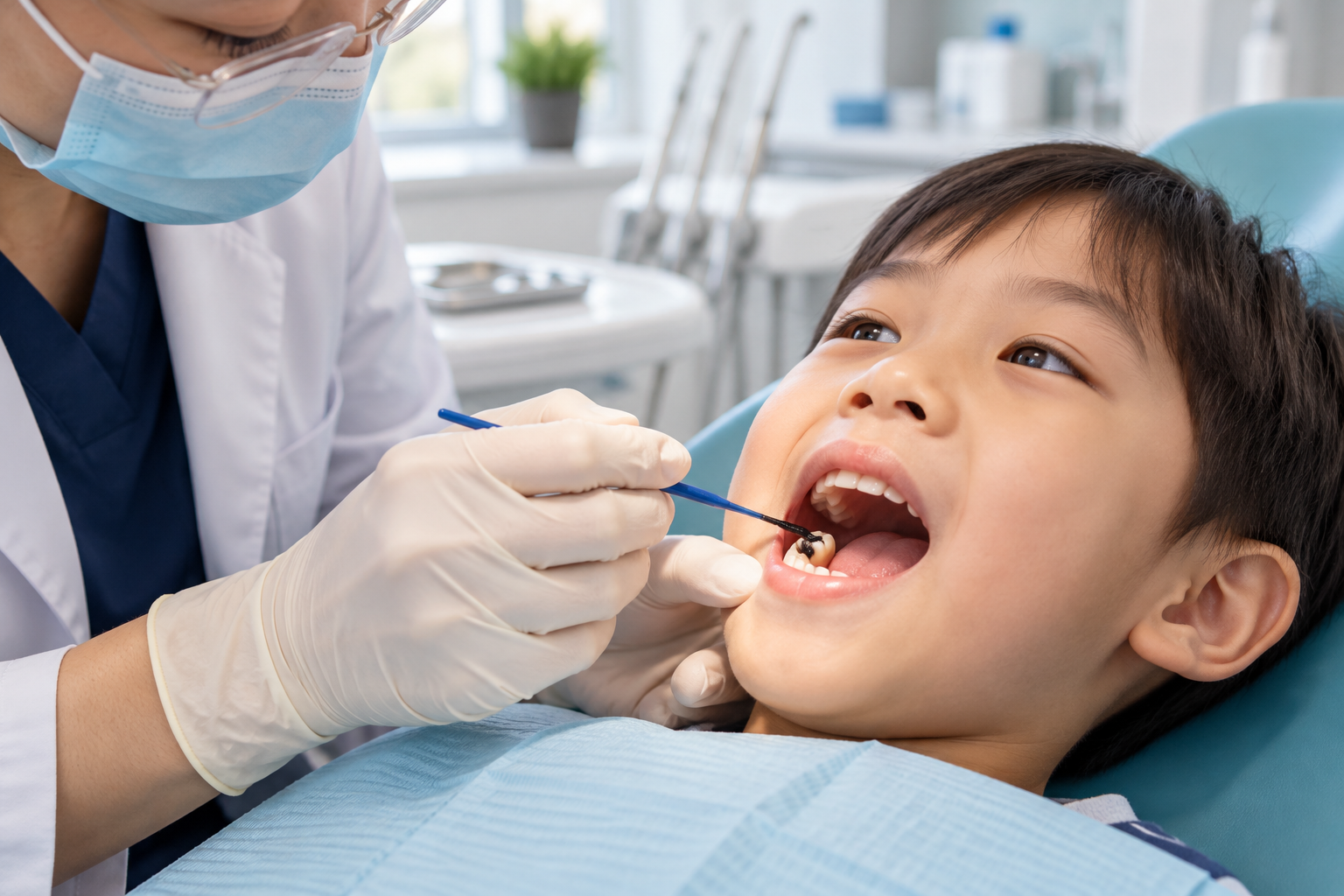
The decayed area treated with SDF usually turns permanently dark or black.
This colour change is limited mainly to the affected carious tooth tissue rather than simply making the entire healthy tooth black. It is an expected effect of treatment and should be discussed before SDF is applied. The American Academy of Pediatric Dentistry (AAPD) recognises SDF as a minimally invasive option that may help prevent or delay more extensive procedures in appropriately selected paediatric patients.
So, when is SDF useful, how does it work, and is it suitable for every child's cavity?
What Is Silver Diamine Fluoride?
Silver diamine fluoride (SDF) is a topical dental liquid containing silver and fluoride.
The two components play different roles. Silver has antimicrobial activity, while fluoride supports remineralisation and strengthens affected tooth structure. Together, they can help arrest the progression of certain carious lesions.
In paediatric dentistry, 38% SDF has been studied extensively for arresting cavitated tooth decay, particularly in primary or "baby" teeth. The AAPD supports its use as part of a broader caries-management plan rather than as a standalone cure for every cavity.
For parents, the simplest way to think about SDF is:
SDF helps control the decay process; it does not rebuild the missing shape of the tooth like a filling does.
That distinction is important.
How Does Silver Diamine Fluoride Work?
A cavity develops when acids produced by oral bacteria progressively weaken and destroy tooth structure.
When SDF is applied to an appropriate cavity, it can help in two main ways.
The silver component has antimicrobial effects that help reduce activity of bacteria within the carious lesion. The fluoride component promotes remineralisation and makes the affected tooth structure more resistant to further breakdown.
When treatment successfully arrests a cavity, the affected dentine commonly becomes darker and harder.
That is why the black colour after SDF treatment is not simply a cosmetic side effect — it is associated with the treated decayed tissue.
However, a dentist must still review the tooth over time to determine whether the cavity has actually become inactive.
Why Might a Dentist Recommend SDF for a Child?
Treating young children can sometimes be challenging, particularly when they have several cavities or are anxious about dental procedures.
SDF can be valuable because the application itself is relatively simple and minimally invasive.
The AAPD identifies several situations where children with cavitated lesions may benefit from SDF, including children with high caries risk, behavioural or medical management challenges, multiple cavities requiring several treatment visits, or teeth that are difficult to restore conventionally.
For example, SDF may be considered when a very young child has a cavity but is not yet able to comfortably tolerate drilling and a filling.
It can also be used as part of caries-control treatment while the dentist develops a longer-term treatment plan.
This does not mean SDF always eliminates the need for a filling, crown or other treatment later.
Instead, it may help stabilise selected decay and give the dentist and parents more options.
Is Silver Diamine Fluoride Effective for Children's Cavities?
Research supports SDF's ability to arrest selected dental caries in children.
The AAPD's clinical guideline conditionally recommends 38% SDF for arresting cavitated lesions in primary teeth as part of a comprehensive caries-management programme.
A large randomised clinical trial published in 2026 involving children aged one to six with severe early childhood caries also found that 38% SDF was significantly more effective than placebo at arresting cavitated dentine lesions over the study period.
At the same time, parents should understand that results are not guaranteed.
Some cavities may continue to progress, and repeat applications may be necessary. Current professional guidance also stresses the need for follow-up monitoring rather than treating SDF as a one-time solution.
Will Silver Diamine Fluoride Make My Child's Tooth Black?
This is probably the most important question for parents.
SDF usually permanently darkens the decayed portion of the tooth that it treats.
The healthy tooth surface is not simply painted black in the same way, but the carious tissue where SDF is applied can become dark brown or black.
For a cavity on a back baby tooth, some parents may consider the colour change an acceptable trade-off if it helps manage the decay with a short, minimally invasive procedure.
For a front tooth, aesthetics may be a much bigger consideration.
Parents should therefore be shown or told clearly what the treated tooth is likely to look like before giving consent.
SDF can also temporarily stain nearby gums or skin if it accidentally contacts soft tissue. AAPD guidance notes that this temporary staining generally differs from the permanent darkening of the treated cavity.
Does SDF Mean My Child Will Never Need Drilling?
Not necessarily.
This is an important misconception to avoid.
SDF may help delay or reduce the immediate need for more invasive treatment in selected cases, but it does not guarantee that a child will never require a filling, crown, extraction or other dental procedure.
Whether additional treatment is needed depends on factors such as how deep the cavity is, whether the decay remains arrested, which tooth is involved, the child's age and when the baby tooth is expected to fall out.
SDF also does not restore a large hole or rebuild the shape of a damaged tooth.
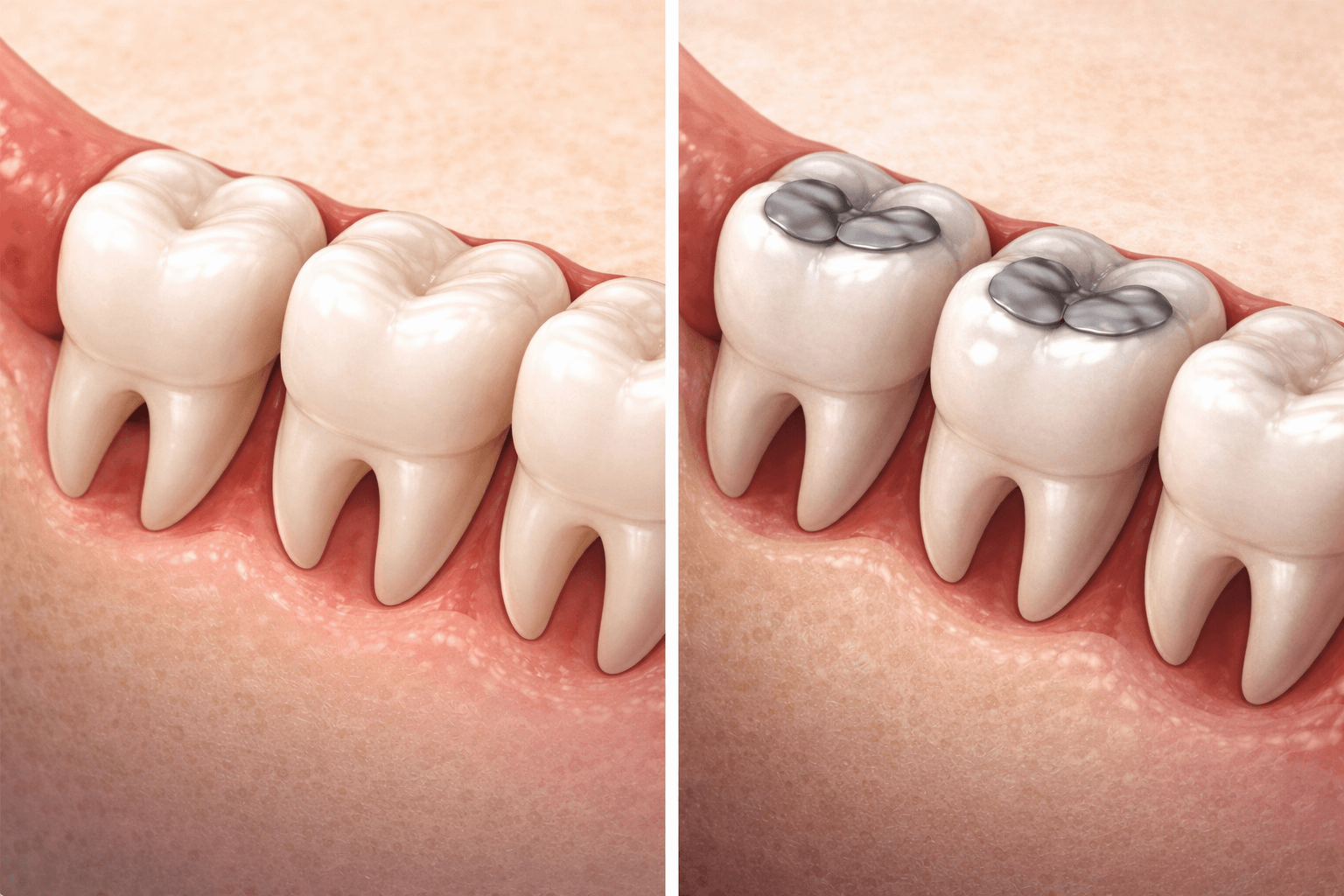
If restoring the tooth's function or structure is necessary, the dentist may later recommend a restorative treatment such as a filling.
Family Dental already provides both children's dental care and fluoride treatment, as well as restorative options when a tooth requires further treatment.
SDF vs Dental Filling: What's the Difference?
SDF and dental fillings serve different purposes.
| SDF | Dental filling |
| Helps arrest selected active decay | Removes/manages decay and restores missing tooth structure |
| Applied as a liquid | Restorative material is placed in the tooth |
| Usually no drilling for SDF application itself | Often involves preparation of the tooth |
| Quick application | Usually requires more chair time |
| Treated decay becomes dark/black | Tooth-coloured options may be available |
| May require repeat application and monitoring | Designed to restore tooth form and function |
A filling may be preferable when the tooth needs structural restoration, while SDF may be considered when the immediate priority is controlling decay with minimal intervention.
Parents who want to understand restorative alternatives can also read Family Dental's guide to the different types of dental fillings.
What Happens During SDF Treatment?
One advantage of SDF is that the application is relatively straightforward.
The dentist first examines the tooth to determine whether SDF is appropriate. Depending on the cavity, radiographs may also be useful to assess how close the decay is to the pulp or nerve of the tooth. AAPD guidance recommends SDF for cavitated lesions that are accessible and are not approaching the pulp with signs or symptoms of pulpal involvement.
The tooth is then isolated and dried before a very small amount of SDF is carefully applied to the affected area.
The material remains in contact with the lesion briefly before excess liquid is removed.
For the SDF application itself, drilling away the decayed dentine is generally not required.
Because the procedure is short, it may be easier for a young or anxious child to tolerate compared with a longer restorative procedure.
Which Children May Benefit Most From SDF?
SDF can be particularly helpful when the dentist needs a minimally invasive approach to control active caries.
Children who may be considered include those who are very young, have difficulty tolerating conventional dental treatment, have several active cavities or need their decay stabilised over multiple visits.
Children with additional healthcare or behavioural needs may also benefit in appropriate cases. The AAPD specifically recognises SDF as an option for children and adolescents, including patients with special healthcare needs.
However, the decision should always be made after examining the individual child and tooth.
When Might SDF Not Be Suitable?
SDF is not appropriate for every cavity.
The AAPD's chairside guidance recommends selecting lesions that do not extend towards the pulp and where there are no symptoms suggesting pulpal involvement, such as spontaneous or lingering pain.
If a child has severe toothache, swelling, infection or decay that has reached the nerve, simply applying SDF may not address the underlying problem.
The tooth may require more definitive dental treatment.
This is why parents should avoid viewing SDF as an over-the-counter cavity treatment or something that can be chosen solely from photographs.
A clinical dental examination remains necessary.
How Many Times Does SDF Need to Be Applied?
SDF is not necessarily a once-only treatment.
Professional guidance notes that repeated applications may be needed to achieve or maintain caries arrest. The ADA also notes that repeat application can improve sustained benefit, while the exact schedule should be determined according to the child's treatment plan.
At follow-up visits, the dentist checks whether the lesion has become harder and inactive or whether the decay is still progressing.
If necessary, SDF may be reapplied or another treatment may be recommended.
Is SDF the Same as Normal Fluoride Varnish?
No.
Both contain fluoride, but they are used differently.
Traditional fluoride varnish is commonly applied to tooth surfaces to help prevent decay, especially in patients with increased cavity risk.
SDF contains both silver and fluoride and is particularly used to arrest existing carious lesions in selected situations.
Evidence comparing SDF with ordinary fluoride therapies also suggests that their roles should not simply be considered interchangeable.
At Family Dental, the dentist can assess your child's cavity risk and determine whether conventional fluoride treatment, SDF or another approach is more appropriate.
What Happens After SDF Treatment?
SDF should be part of an ongoing oral-health plan.
Even if one cavity becomes arrested, the factors that caused the decay may still be present.
Parents should continue helping young children brush with fluoride toothpaste as recommended for their age, manage frequent sugary foods and drinks, and attend follow-up dental visits.
The treated cavity also needs to be monitored.
SDF does not make the child immune to future cavities, nor does it mean that preventive dental care is no longer necessary.
Frequently Asked Questions About Silver Diamine Fluoride for Children
Is silver diamine fluoride painful?
The application itself is minimally invasive and generally does not require drilling or a local anaesthetic solely to place the SDF. This can make it useful for young children who have difficulty tolerating longer dental treatment.
Will SDF turn the whole tooth black?
Usually, it is the treated decayed area that becomes permanently dark or black. This cosmetic effect should be discussed before treatment.
Can SDF be used on baby teeth?
Yes. Much of the evidence and paediatric guidance for SDF involves arresting cavitated decay in primary or baby teeth.
Does SDF remove the cavity?
No. SDF aims to arrest or slow the decay process. It does not physically rebuild the missing tooth structure like a filling.
Can SDF prevent my child from needing a filling?
It may delay or reduce the immediate need for restorative treatment in selected cases, but this cannot be guaranteed. Some teeth may still require fillings, crowns or other treatment later.
How fast is SDF treatment?
Application is usually brief compared with conventional restorative procedures. The exact appointment time depends on the number of teeth being treated and the child's cooperation.
Does my child need follow-up after SDF?
Yes. Follow-up is important to confirm whether the cavity has arrested and whether another application or additional dental treatment is needed.
Is Silver Diamine Fluoride Right for Your Child?
Silver diamine fluoride for children can provide a useful minimally invasive option for managing selected cavities, particularly when a young child may find conventional restorative treatment difficult.
Its main advantages are the quick application, the absence of drilling for the SDF application itself and its ability to help arrest active decay.
Its most visible disadvantage is equally important: the treated decayed area usually turns permanently black.
For some back baby teeth, that trade-off may be acceptable. For visible front teeth, parents may feel differently.
The right decision therefore depends on the depth and location of the cavity, the child's age and cooperation, symptoms, aesthetic concerns and the longer-term treatment plan.
Family Dental provides paediatric dentistry in Penang for children up to age seven, alongside preventive fluoride care and restorative dental treatment. If your child has a cavity and you would like to know whether SDF may be appropriate, book a dental assessment with Family Dental.
A dentist can examine the affected tooth, explain the expected black staining and discuss SDF alongside other available treatment options before you decide how to proceed.